You've got siding damage. Or you've got siding that's seen better days. The question: fix what's wrong, or tear it all off and start fresh?
Both answers can be right. Both can be wrong. Here's how to figure out which applies to your situation.
When Repair Is the Right Call
One Area Got Hit
Storm took out a few panels. Ladder put a hole in the siding. Tree branch left a mark. Baseball happened.
If the damage is in one spot—or a few spots—and everything else is fine, repair makes sense.
Cost: Usually $150-800 per repair area. Maybe less, maybe more, depending on accessibility and material.
You Can Actually Match It
This matters more than people realize.
Your siding was installed in 2005. You need to match it now. Can you?
- Vinyl: Maybe. Colors fade. Profiles change. Even if the manufacturer still makes your color, 20 years of sun exposure means new pieces look different.
- Fiber cement: Easier to match. Less fading. Better odds of success.
- Wood: Depends on species and profile. Often can be matched reasonably well.
If you can't get a decent match, repairs look like patches. That might bother you, might not.
Nothing's Wrong Underneath
This is the key question. Is the damage skin-deep, or is there more going on?
Pull back that damaged section. What do you see?
- House wrap intact, sheathing solid: Good news. Repair and move on.
- House wrap damaged, sheathing wet: Bigger problem. Repair might still work, but you need to fix what's underneath first.
- Rot, mold, structural damage: Now we're talking about more than siding repair.
Your Siding Has Life Left
How old is your siding?
| Type | Expected Life |
|---|---|
| Vinyl | 20-30 years |
| Fiber cement | 30-50 years |
| LP SmartSide | 25-40 years |
| Wood | 15-40 years |
If your siding is 10 years old and expected to last 30, repairs make sense. If it's 28 years old and starting to show age everywhere, repairs just delay the inevitable.
When Replacement Makes More Sense
Problems Everywhere
You fix the south wall. Then the east wall starts showing issues. Then you notice the west wall. Then...
If damage is spreading or appearing in multiple places, your siding is telling you something. It's done. Piecemeal repairs become more expensive than just replacing everything.
The Math Doesn't Work
Here's the rule I use: If repairs cost more than 30-40% of replacement, replace.
Example:
- Replacement cost: $25,000
- 30-40% threshold: $7,500-$10,000
If your repair estimate is hitting $8,000... you're most of the way to a new siding job. Might as well get new everything with a fresh warranty instead of patching old stuff that'll need replacing anyway.
You Can't Match the Material
Sometimes the material is discontinued. Sometimes the color was custom. Sometimes it's just too old.
If repairs will be obviously visible—and that bothers you—replacement might make sense even if the damage is limited.
Some people don't care. Fair enough. But if mismatched repairs will make you cringe every time you pull in the driveway, factor that in.
There's Damage Behind It
Here's where siding repair becomes siding replacement:
You open up a repair area. You find wet sheathing. Or rot. Or mold. Or insect damage.
One spot like that? Could still be repair plus remediation.
Multiple spots? Your siding has been failing to protect your house. It's not just siding—it's everything behind the siding. Time to take it all down, fix what's underneath, and do it right.
Your Siding Is Just Old
Nothing lasts forever. If you're already doing repairs every year or two, at some point it's cheaper and easier to just replace.
New siding means:
- No more annual repair calls
- Fresh warranty
- Better energy efficiency if you want
- Updated appearance
- Clean slate
You Want Something Different
Maybe your aluminum siding works fine but looks dated. Maybe you're tired of painting your wood siding every few years. Maybe you've always wanted fiber cement.
Repair isn't the path to different. Replacement is.
The Decision Framework
Ask yourself these questions:
1. Is damage localized or widespread?
- Localized → Consider repair
- Widespread → Lean toward replacement
2. Can I match the existing material?
- Yes → Repair is viable
- No → How much does the mismatch bother you?
3. How old is my siding?
- Under 15 years → Repair makes sense
- 15-25 years → Evaluate carefully
- Over 25 years → Replacement is probably coming soon anyway
4. What's behind the siding?
- Everything's fine → Repair the surface
- Some damage → Repair plus remediation
- Widespread issues → Replacement with substrate repair
5. What's my total repair cost vs. replacement?
- Under 30% → Repair
- 30-50% → Tough call
- Over 50% → Replace
What About "Spot" Replacement?
Sometimes you can split the difference.
One wall is shot but three walls are fine. Replace the bad wall, leave the others.
This works if:
- You can match the material reasonably well
- The other walls are genuinely in good shape (not just "okay for now")
- It makes financial sense
It doesn't work if you're just delaying inevitable replacement of everything else.
What We Actually Do
Here's our process:
First, we look at everything. Not just the area you called about. We walk the whole house. What's the overall condition? Where are problems starting?
Then we're honest. If repair makes sense, we'll tell you. If you're better off replacing, we'll tell you that too. If we're not sure, we'll explain the tradeoffs and let you decide.
We don't push replacement when repair works. We also don't do repairs that we know won't last just to get a small check today.
We document what we find. Photos, notes, clear explanation. You'll know exactly what we saw and why we're recommending what we're recommending.
The Cost Reality
Typical repair costs:
- Single panel replacement: $100-300
- Multiple panel section: $300-800
- Wall section with substrate repair: $1,000-3,000+
Typical replacement costs:
- Vinyl (whole house): $8,000-20,000
- Fiber cement (whole house): $16,000-30,000
- LP SmartSide (whole house): $14,000-26,000
The gap seems huge. But repairs add up. Three repair calls over five years, then replacement anyway... you might have been better off replacing from the start.
Need Help Deciding?
Come look. Give you an honest read. Tell you what we'd do if it were our house.
No charge for looking. No pressure either way. If you end up just needing a small repair, great. If it turns out replacement makes more sense, we'll explain why.
Call or send a message. We'll take a look and give you real options.
Based in Easton, working throughout the Lehigh Valley and into Jersey. Licensed in PA, NJ, and NY.
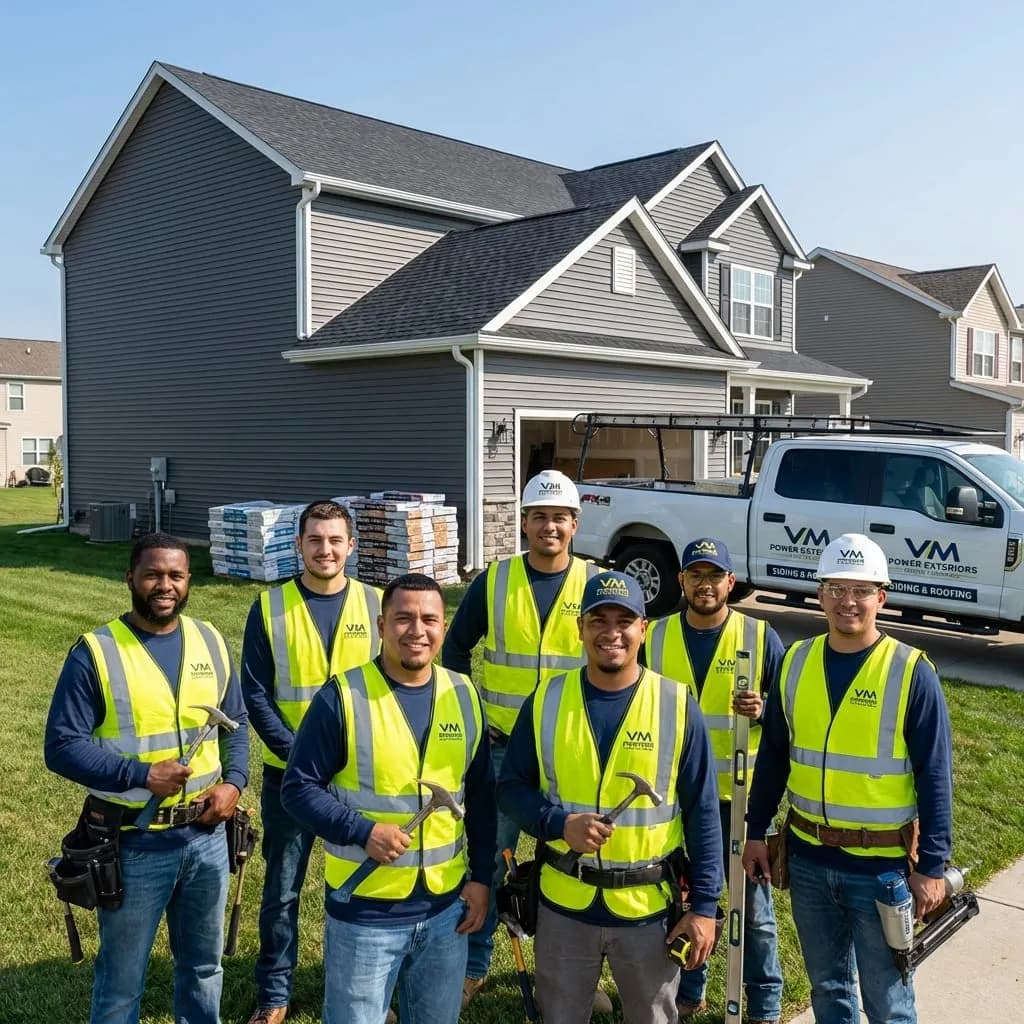
Written by
VM Exteriors TeamExpert Contractors
The VM Power Exteriors team combines decades of hands-on experience in roofing, siding, gutters, and exterior home improvement. We're committed to providing honest advice and quality workmanship to every homeowner we serve.
Was this article helpful?
Your feedback helps us improve our content